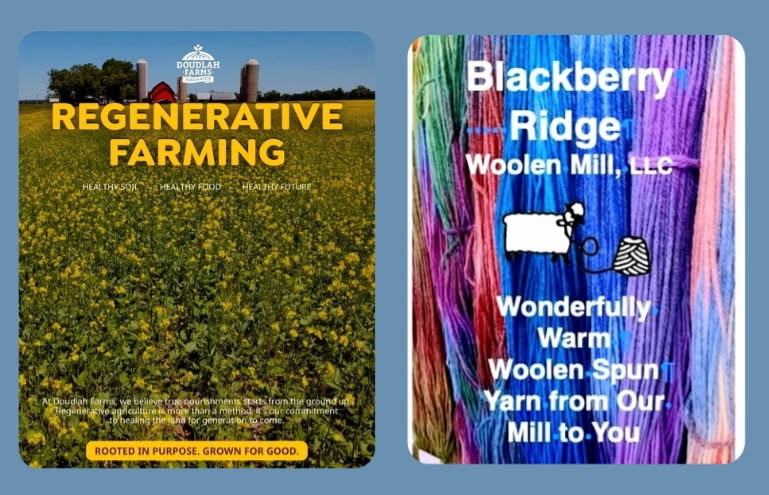
(Featured photos courtesy Doudlah Farms and Blackberry Ridge Woolen Mill)
Two southern Wisconsin agriculture-related businesses are working to build stronger local supply chains — from turning raw wool into yarn to expanding regional processing for dry beans. Staff from U.S. Rep. Mark Pocan‘s office recently visited Blackberry Ridge Woolen Mill in Mount Horeb and Doudlah Farms in Evansville with Wisconsin Farmers Union staff. It gave both businesses the opportunity to showcase their work, explain challenges facing their industries, and discuss plans for future growth.
Pocan’s office regularly looks for opportunities to visit farmers and learn more about the diversity of agricultural operations across the congressional district.
Woolen Mill aims to expand fiber processing in Wisconsin
New owners Leslie Schroeder and business partner Sarah Best demonstrated how wool is processed into yarn. And at Blackberry Ridge Woolen Mill, they do it using equipment that is more than 100 years old. Schroeder and Best shared the step-by-step process of transforming wool into yarn, and discussed barriers to fiber processing in Wisconsin, including wool, flax linen, and other natural fibers.
One major challenge is the decline of fiber-processing infrastructure across the United States. The owners pointed to a shortage of wool-scouring facilities — where raw wool is cleaned before further processing — as a particular bottleneck. They said the only facility available to them is in Texas.
By purchasing the mill, Schroeder and Best hope to make mid-sized fiber processing more accessible.
The business also has a connection to the state’s fiber-processing history. Anne Bosch and her husband founded Blackberry Ridge Woolen Mill and remain involved as mentors to the new owners. Expanding processing capacity could create more opportunities for fiber producers to turn their raw materials into finished products closer to home.
Organic family farm prepares for regional bean processing
Doudlah Farms near Evansville is a multi-generational family operation combining organic farming practices with plans to expand regional food processing. Mark Doudlah, a sixth-generation farmer, works alongside his wife, Lucy, and their son Jason, a seventh-generation farmer. The family grows dry beans, popcorn, ancient grains, and other crops on more than 1,000 acres. The farm is certified organic and uses biodynamic practices intended to build soil health and produce healthy food for the community.
During the visit, the family showed its packaging operation and specialized equipment, explained its cover-crop rotations, and shared what inspired its transition to organic farming.
The farm is also preparing for a major expansion. The Doudlah family recently received a Resilient Food Systems Infrastructure (RFSI) grant to develop the Farmers Accessing Resilient Markets Through Wisconsin Infrastructure for Sustainable Enterprises (FARMWISE) project — a regional processing facility for dry beans.
The group toured the construction site, where work is underway. A regional facility could help address processing needs for dry bean growers and strengthen infrastructure connecting agricultural production with food markets.
Farm visits offer a direct line to policymakers
The visits highlight how Wisconsin agriculture-related businesses are addressing challenges that extend beyond individual farms. For fiber producers, limited processing capacity can make it difficult to turn locally grown materials into finished products. For dry bean growers, regional processing infrastructure could open new opportunities to move crops through the supply chain.
And seeing the operations firsthand can help policymakers better understand what businesses need to grow, invest, and contribute to their local economies.
Leave a Reply