
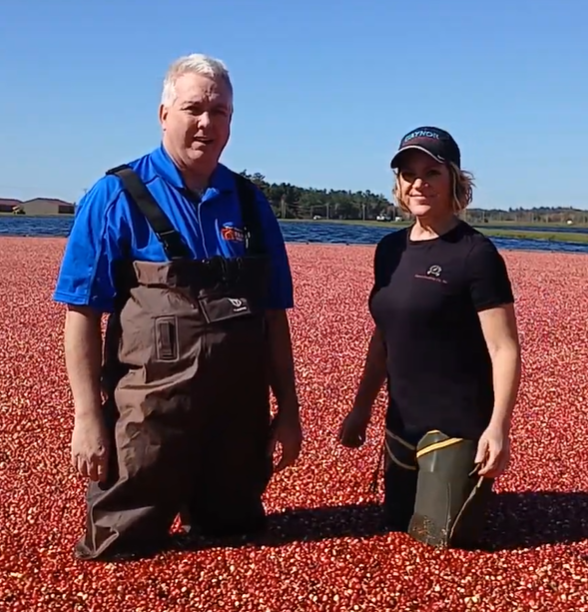
150 years of family farming is being celebrated this harvest season at Gaynor Cranberry Company west of Wisconsin Rapids. Heidi Slinkman represents the fifth generation to work the bogs. And technology has transformed the operation from a back-breaking era of manual hand rakes.
“We have taken the technology of the hand rake and evolved it into a modern day picker, so our John Deere tractor has an implement on the front and on the back, and if you can imagine this — on it’s tracks, will drive on the vines and it will comb through the vines and pluck the berries off, and as they’re plucking off, they will float to the top because they have four hollow pockets on the inside, just like our heart chambers. As they’re floating, we’ll raise the water, and now we have an easier way to corral the berries,” Slinkman explained.
LISTEN to Larry Lee’s interview with Heidi Slinkman here:
While fall marks the peak of harvest activity, cranberry management is a year-round commitment. Farmers must simultaneously protect the current yield and the following year’s production cycle.
“We grow two crops in one year but we only harvest one. How is that possible? So, on those uprights where the berries are growing, there’s a tiny little baby bud on the top, and it’s hardy enough that you can stand on it when we’re harvesting, but it will not survive hail and it will not survive a frost event, so it’s our responsibility to take care of not only the land but also next year’s crop, so we are protecting two crops in one year,” Slinkman said.
As a native Wisconsin crop, cranberries thrive on vines in sandy soil rather than standing water. However, water remains an indispensable tool for frost protection and winter dormancy.
“They also need protection when it’s really cold outside,” she explained. “We run irrigation lines and they go in a circle to create just enough friction and heat to keep those cranberries protected. Without water, we don’t have the ability to protect our cranberries.”
Preparing the fields for winter follows a similar deliberate process.
“We’ll blanket them with a body of water and it will freeze like an ice skating pond, and then we’ll put some sand over them to insulate them. In the springtime, the sand will sift and promote upward growth,” Slinkman said.
Leave a Reply