
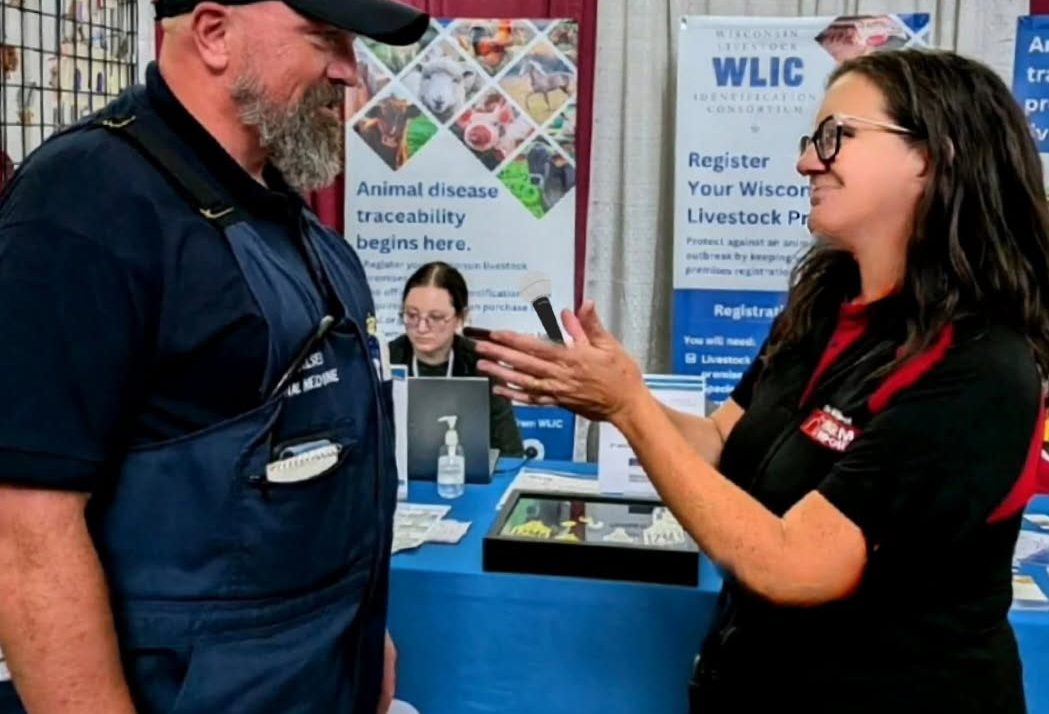
A new one-on-one interview with the director of the Wisconsin Veterinary Diagnostic Laboratory, is providing an important update on epizootic hemorrhagic disease (EHD), after the virus was recently detected in dairy cattle in Waukesha County.
Keith Poulsen talked with Teri Barr, while at the World Dairy Expo in Madison, Wisconsin. He says though the finding is unusual in cattle, there is little reason for Wisconsin farmers or consumers to be alarmed.
LISTEN to Teri Barr’s interview with Keith Poulsen here:
EHD is known as a disease affecting Wisconsin’s white-tailed deer. The virus is spread by biting midges — small insects that feed on warm-blooded animals.
“It’s a virus that’s transmitted by biting midges, which are insects,” Poulsen said.
The Wisconsin Department of Agriculture, Trade and Consumer Protection (DATCP) confirmed that samples from non-lactating dairy cattle in Waukesha County tested positive for EHD. The disease has also been detected in wild and captive deer in the same area.
Why is EHD unusual in cattle?
Poulsen says cattle can be exposed to EHD, but it is rare for dairy or beef cattle to develop a noticeable clinical disease. In the Waukesha County case, the cattle showed lesions around their feet. It prompted the farm’s veterinarian to contact DATCP, and samples were sent to the Wisconsin Veterinary Diagnostic Laboratory.
Poulsen says that process is exactly what Wisconsin’s animal-health system is designed to do.
“The key message here is that this is normal, that we do these diagnostics,” Poulsen explained. “Being able to identify the farms and to know what’s going on really quickly is key for us.”
The testing allowed animal-health officials to identify EHD while also ruling out other diseases of greater economic concern.
What should Wisconsin farmers do?
Poulsen says farmers don’t need to make major changes because of the Waukesha County case. Instead, your should continue the insect-control and animal-management practices you may already have in place:
- Maintaining good barn ventilation.
- Continuing fly and external parasite control.
- Using appropriate insect-control products.
- Providing good bedding and footing.
- Watching animals for unusual clinical signs.
- Contacting a veterinarian when something doesn’t look right.
And there is another factor working in Wisconsin farmers’ favor — the arrival of a hard frost.
“That’s the great part about living in Wisconsin. We have that hard frost that gets rid of a lot of the pests that we deal with in the warmer months,” Poulsen said.
Is EHD a food safety concern?
Poulsen says EHD is not a foodborne disease and is not a zoonotic disease. That means it is not known to spread from infected cattle to people.
“Meat and milk, everything is safe, and there’s really no risk to human health at all,” Poulsen confirmed.
Poulsen added that, when discussing biology, he prefers to say the risk is “very, very low” rather than absolute zero because biological systems are rarely described in absolute terms.
Wisconsin has a strong surveillance system in place
Although the discovery in dairy cattle is unusual, Poulsen says Wisconsin has an extensive animal-health network designed to identify and investigate diseases quickly. The Wisconsin Veterinary Diagnostic Laboratory works with DATCP and other animal-health organizations to monitor disease and respond when concerns arise.
“We know what’s going on,” Poulsen said. “Our network is here to do that surveillance, and then to provide education to our dairy farmers and anyone interested.”
Poulsen believes EHD is something to monitor, but it should not overshadow the many other challenges Wisconsin farmers are facing this time of year.
Leave a Reply