
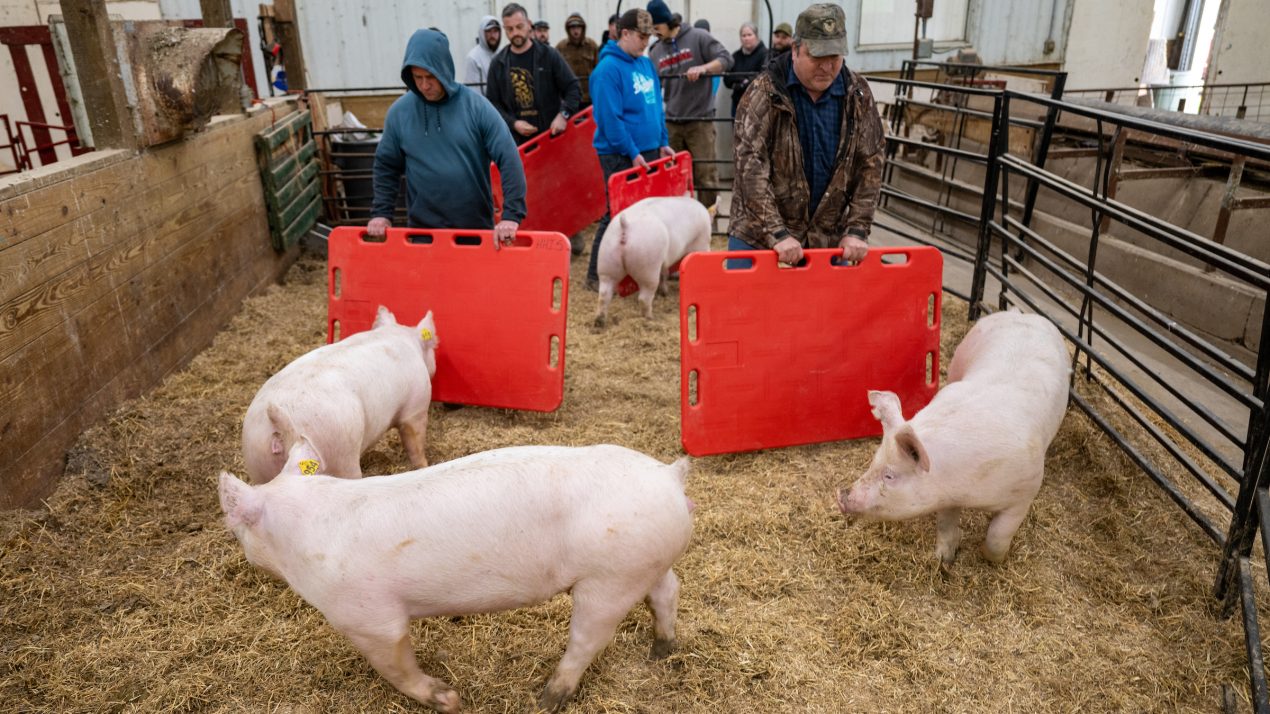
To understand how to handle cattle safely and humanely, meat industry professionals are stepping into their hooves—virtually. In April, 17 meat industry employees from across the country gathered at the University of Wisconsin-River Falls (UWRF) for an interactive, hands-on workshop hosted by the Humane Handling Institute (HHI). The program equips participants with safe and humane livestock handling techniques to improve animal welfare and ensure processors meet critical USDA regulations.
“We built this program from the ground up for you,” said Kurt Vogel, director and founder of HHI and professor of animal welfare and behavior at UWRF. “We believe people learn best when they are having fun.”
Keep The Animals Calm
U.S. meat processing facilities must strictly adhere to the Humane Methods of Slaughter Act. The law requires processors to render all animals immediately insensible with a single stun, handle animals with minimal excitement and risk of injury, and prevent egregious acts of abuse. Because a single allegation of abuse can shut down operations, processors must pass rigorous USDA inspections. Despite these high stakes, the United States lacked training centers for humane handling and stunning before Vogel founded HHI in 2022.
“Our mission is to improve animal welfare, worker safety and trust in food animal agriculture through robust and meaningful education, outreach and research,” Vogel said.
During the two-day workshop, instructors taught participants the anatomy of a cow’s head, demonstrated electrical and captive bolt stunners, and guided practice sessions with model heads. Attendees also learned the principles of livestock handling and behavior by working directly with live sheep, goats, pigs, and cattle on the university’s farm.
See Exactly What The Livestock See
The program recently introduced a unique learning tool: cow vision goggles.
“There’s only one place in North America you can have this experience,” said HHI Program Manager Ashlynn Kirk as she introduced the goggles to the group.
Kirk spearheaded the effort to bring the innovative technology to UWRF from a German company in late 2025. Formally known as the Animal Eye Simulator, cow vision combines augmented reality goggles and software to let participants see as a cow would see—experiencing wide peripheral vision with limited color, poor depth perception, and slow adjustment to light.
“Whoa!” said Richard Flannery of Central Point, Ore., when he put the goggles on. “Just… whoa.”
“It was trippy,” Flannery said after navigating through a barn and cattle chute wearing the goggles. “It’s really interesting seeing through the eyes of a cow. It was really disorienting from my normal point of view.”
Through the goggles, participants saw how simple environmental factors—like a shiny tarp on the ground, sunlight shining through an open door, or a yellow vest hanging on a railing—could cause cattle to freeze in a facility.
Attendees and business owners emphasized that the workshops build the critical skills and confidence employees need for their daily work. Clay Cooper, an employee for a beef, pork, and lamb processor in Ohio, noted he is fairly new to the industry and learned a lot from the workshop.
“The instructors were really passionate about humane handling and passionate about the food industry—that was really obvious in their teaching,” Cooper said. “My biggest takeaway would probably be the animals’ point of view when they’re handled through a processing facility and the low-stress handling of the animals.”
Training Helped Family Grow New Business
Shawna Montgomery, co-owner of Montgomery’s Meat Company with locations in California and Oregon, attended her second workshop with staff from her family-owned company. A year and a half earlier, before attending her first workshop, Montgomery and her husband struggled to open a USDA facility from scratch while navigating complex terminology, rules, and regulations.
“I was about to give up when I came here because there was no template or instruction,” Montgomery said.
After attending the class and receiving guidance to create a humane handling plan, Montgomery left with the inspiration and confidence to launch a successful operation.
“We have had zero incidents of any type of problem,” Montgomery said. “I feel that attending these classes is what led us to that success.”
HHI offers workshops for meat industry employees and dedicated sessions for UWRF students. The next professional Humane Handling and Stunning workshop is Sept. 17-18.
For more information or to register, visit uwrf.edu/humane-handling-institute/learn-us.
Leave a Reply