
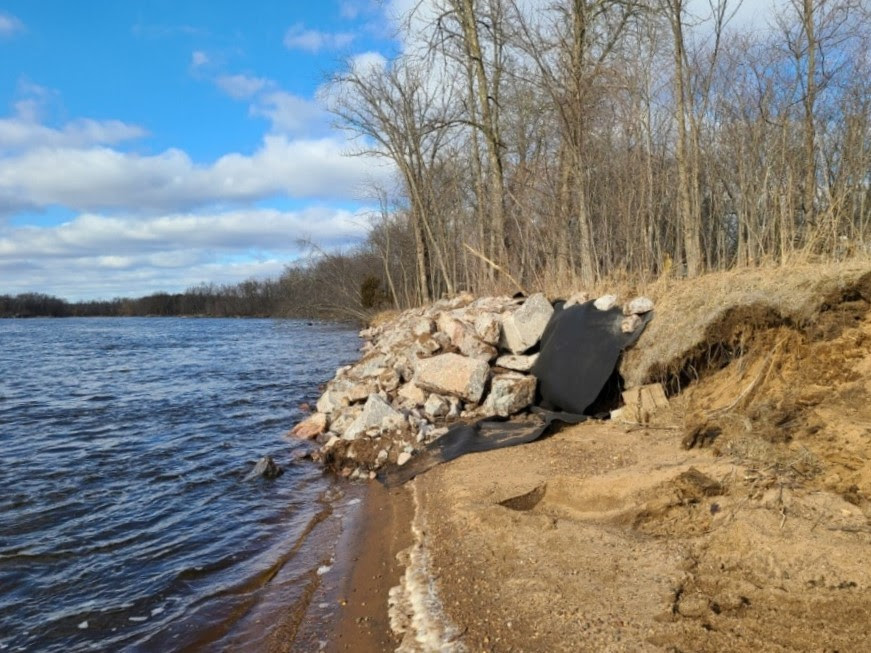
The Wisconsin Department of Natural Resources (DNR) is currently reinforcing 525 feet of rapidly eroding shoreline along the Wisconsin River with large riprap downstream from the confluence of the Tenmile Creek.
Riprap is a blanket of rocks fitted to the slope and shape of a shoreline to prevent soil erosion.
“Water quality begins on the land as all the precipitation that falls within the watershed (9,156 sq. miles of land) drains towards the river. The runoff carries soil particles and dissolved nutrients like phosphorus to the water, leading to what is known as nonpoint source pollution,” said Scott Provost, DNR Water Resources Specialist. “Nonpoint source pollution can create large blue-green algae blooms and other water quality problems for downstream lakes. We want to fix that.”
The riprap effort is part of the Wisconsin River Total Maximum Daily Load (TMDL) project to improve water quality in the Wisconsin River watershed. Approved in 2019 by the U.S. Environmental Protection Agency (EPA), the project aims to reduce phosphorus in the water loading into the Wisconsin River from Vilas County to Lake Wisconsin in Columbia County.
Thousands of nonpoint source pollution sites across Wisconsin combine with wastewater treatment plants (known as point sources) to contribute to poor water quality. The DNR partners with many state agencies, municipalities and residents to address the sources of pollution at their origins.
Adding riprap along the Wisconsin River is expected to prevent an estimated 767 tons of sediment and 212 pounds of phosphorus loading per year to Lake Petenwell.
There is more to this project than erosion and nutrient control. The location of this site has a unique combination of flow and depth that could support spawning sturgeon with the right rock.
Since 1997, the DNR has collected eggs and milt from adult sturgeon below the Kilbourn Dam in Wisconsin Dells. Eggs are hatched and raised at the Wild Rose State Fish Hatchery. As a result, more than 300,000 sturgeon have been stocked, and female sturgeon are just starting to reach spawning age. The placement of riprap with other submerged components like anchored root wads can create spawning habitats for sturgeon, serve as habitat for Flathead Catfish and reduce nonpoint source pollution.
Funding for the riprap project was made possible through a targeted runoff management cost-share grant to the Wood County Land and Water Conservation Department and landowners. It is one of many projects being funded by federal, state, county and landowner partners dedicated to improving water quality in the Wisconsin River Basin.
“The only way to address these issues is to work collaboratively with partners,” Provost said. “We were fortunate to find that winning combination of grant funding and strong public/private partnership with landowners, Wood County and other organizations like Petenwell and Castle Rock Stewards.”
More information about the Wisconsin River TMDL project is available on the DNR website.

Leave a Reply